Your cart (0)
Your cart is empty
Tax included and shipping calculated at checkout

Drawer menu
Your cart is empty
Tax included and shipping calculated at checkout

Best overall: an engine-specific, closed-loop baffled catch can kit. Best for engines with separate ventilation routes: a correctly routed dual-can kit. Best for custom engine bays: a universal baffled kit with a planned installation. This 2026 guide compares those layouts so you can choose by engine fitment, ventilation routing, and service access—not can size or appearance.
A catch can separates oil droplets from crankcase vapors before those vapors return to the intake. It does not repair worn piston rings, a failed ventilation valve, or a turbocharger oil leak.
Turbocharged engines need ventilation routing that works under both intake vacuum and boost. Install a can incorrectly and you risk restricting that ventilation or connecting intake pressure to a path that should be isolated.
The best catch can is the one that separates oil without disrupting the engine’s ventilation system. That is the buying rule for this 2026 guide, whether you are planning a daily driver or a modified build through PNW Performance.
Use these criteria before comparing individual kits. A polished housing tells you almost nothing about how the assembly works on your engine.
A kit earns its place through those details. Claims about added horsepower or eliminating intake deposits are not substitutes for them.
These rankings compare kit designs. The best choice within each design still depends on the exact engine and installation instructions.
| Rank and layout | Best for | Standout feature | Key limitation |
|---|---|---|---|
| 1. Engine-specific closed-loop baffled kit | Daily-driven turbo builds | Defined mounting and routing for the application | Covers only the ventilation path included in its design |
| 2. Engine-specific dual-can kit | Engines requiring separation on distinct ventilation routes | Separate collection on separately routed circuits | More connections and collection points to maintain |
| 3. Universal baffled kit | Custom engine bays and fabricated installations | Flexible placement and hose routing | The installer must resolve fitment and ventilation compatibility |
A closed-loop kit returns treated crankcase vapors to the intended intake connection. A vent-to-atmosphere arrangement releases them outside that circuit; it is not interchangeable with a closed-loop installation.
An engine-specific closed-loop kit places a separator in a defined crankcase ventilation path. It returns the remaining vapors to the intake rather than treating an open breather as a substitute for the factory arrangement.
This is the default choice for a street-driven turbo build because you can check the proposed installation against an engine-specific diagram. The actual kit must still provide the correct bracket, connections, and routing instructions; the words direct fit do not settle those questions.
Engine-specific closed-loop kit pros:
Engine-specific closed-loop kit cons:
For a 2026 purchase, verify the engine application rather than relying on a vehicle badge alone. Check whether your intake, turbo plumbing, or other modifications occupy the proposed mounting area.
Best for: A daily-driven turbocharged vehicle with a documented, compatible installation.
Verdict: Buy an engine-specific closed-loop kit when its routing and fitment match your build.
A dual-can arrangement uses separate collectors on distinct ventilation paths. It makes sense when the engine’s layout and the kit’s instructions establish a reason to treat those paths separately.
Two cans are not automatically better than one. What matters is where vapors travel under different operating conditions and whether each separator belongs in its assigned circuit.
Engine-specific dual-can kit pros:
Engine-specific dual-can kit cons:
Before choosing this layout, trace both routes on the installation diagram. Identify where each hose starts, where it ends, and how the arrangement handles the difference between vacuum and boost.
Keep service records for each collector separately. Different amounts of collected liquid do not, by themselves, prove a fault or establish that one circuit needs a larger can.
Best for: An engine with distinct ventilation routes addressed by a documented dual-can installation.
Verdict: Buy only when the engine’s routing justifies separate collectors; skip a second can added without that reason.
A universal baffled kit supplies a separator that you integrate into a custom installation. It does not establish that the included hoses, fittings, bracket, or valves suit your engine.
This layout belongs in a build where you are already planning the mounting and ventilation connections. It is not a shortcut around understanding the factory system.
Universal baffled kit pros:
Universal baffled kit cons:
Do not choose a universal kit solely because its ports resemble the factory hose size. The complete assembly includes adapters, bends, internal passages, and any valves—not just the visible hose.
For PNW Performance enthusiasts building around aftermarket accessories, the same rule applies: choose the ventilation layout before choosing where the can looks best. Custom placement is useful only when it preserves the required operation.
Best for: A custom engine bay with a planned, technically verified installation.
Verdict: Hold until the mounting, routing, and component requirements are settled.
For your 2026 shortlist, compare installation documents before comparing finishes. Work through this sequence with the engine configuration in front of you.
Record the exact engine designation and relevant modifications. A shared model name does not establish that different engines use the same ventilation system.
Identify the factory crankcase ventilation connections. Follow the proposed kit diagram and confirm which factory valves, separators, sensors, or heated components remain in place.
Check valve requirements and flow direction against the application instructions. Do not add, remove, or reverse a valve because another engine’s installation uses a different arrangement.
Confirm clearance from belts, fans, hot exhaust components, and moving assemblies. Check that hoses will not kink, rub, or pull tight as the engine moves.
Make sure you can inspect and empty the collection chamber. An inaccessible drain turns a routine maintenance task into a reason to postpone it.
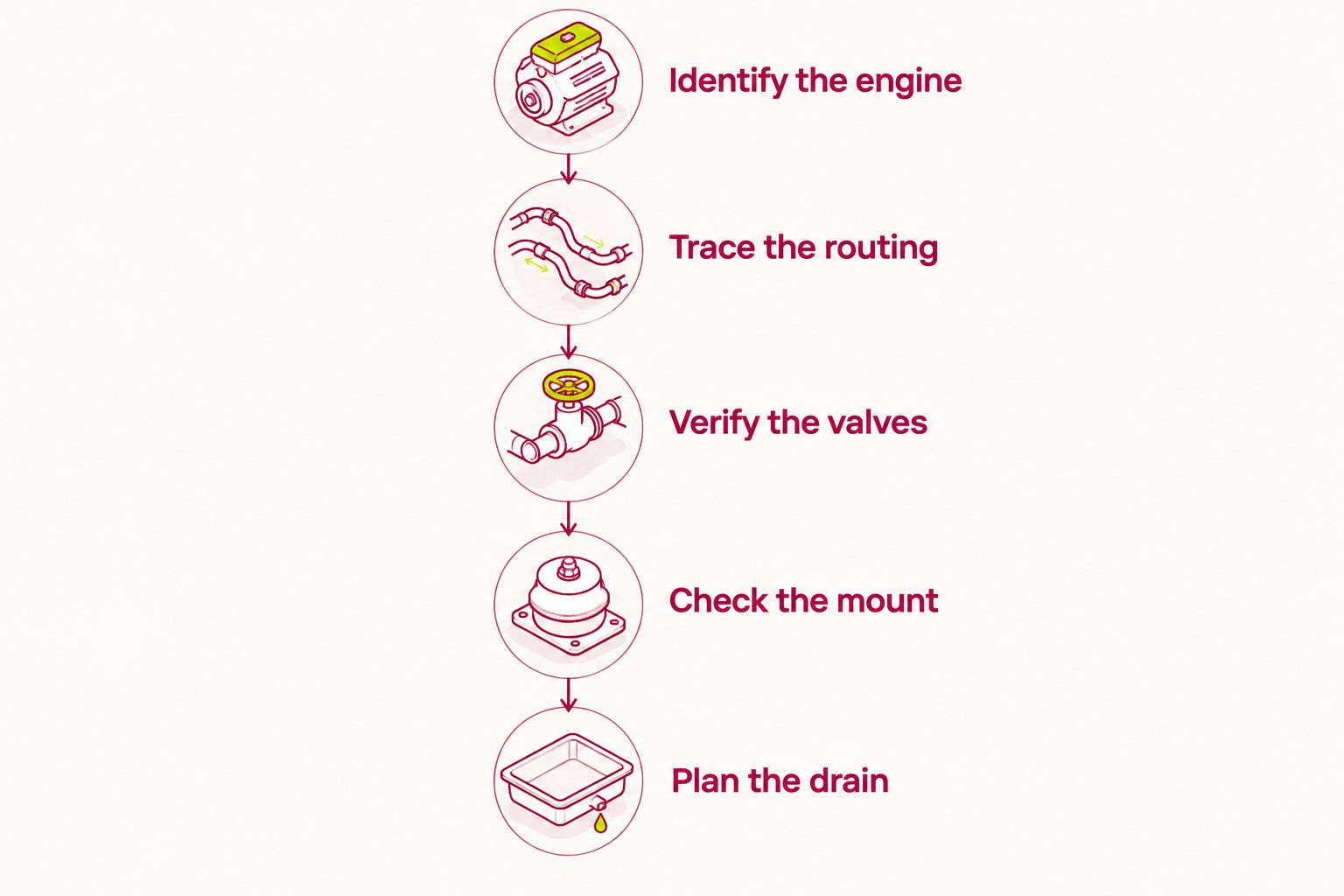
After those checks, review the complete parts list. Resolve missing installation components before taking the existing ventilation system apart.
A catch can is an oil-separation device, not a repair for every oil-related symptom. Persistent smoke, unusual oil consumption, or oil leaks need diagnosis rather than an automatic parts order.
Direct-injection intake valves do not receive the same fuel washing as valves in a port-injected arrangement. Reducing oil carried through a ventilation route does not prove that a catch can will eliminate intake-valve deposits or remove deposits already present.
Likewise, collected liquid is not a horsepower measurement. The amount depends on the engine, operating conditions, ventilation route, and service interval.
For PNW Performance turbo builds, a catch can is a supporting component—not a substitute for diagnosis. Repair a failed ventilation component before adding hardware around it.
Inspect the collector frequently after installation and establish a routine from what you actually find. There is no single emptying interval that fits every engine, climate, and driving pattern.
Use a simple log with distance in miles, collected liquid in milliliters, and ambient temperature in degrees Fahrenheit. Those measurements give your own maintenance decisions a basis; another driver’s collection rate does not.
Cold-weather use deserves attention because water can condense in the ventilation system. Follow the application’s cold-weather instructions and address any freezing or blockage concern before continuing to operate the vehicle.
At each inspection, check the mount, hose condition, fittings, seals, and drain closure. A catch can needs both collection capacity and a functioning path through the system.
This 2026 ranking puts documented engine fitment and correct ventilation ahead of appearance. Service access and installation complexity decide which layout makes sense for your use.
The engine-specific closed-loop kit ranks first as the default street-build layout. Dual cans address a narrower routing requirement, while a universal kit leaves more installation decisions with the builder.
Choose an engine-specific closed-loop baffled kit unless your engine’s routing or custom installation creates a clear reason to choose otherwise. Confirm the exact application, complete hose path, required valves, and drain access before ordering.
Choose dual cans for documented separate circuits. Choose a universal kit when you have a complete installation plan—not simply because you can find room for the housing.
What’s the best oil catch can kit for turbocharged engines?
An engine-specific, closed-loop baffled kit is the default choice for a daily-driven turbocharged engine. Confirm that its routing, valves, mounting, and service access suit your exact application.
Is a dual catch can kit better than a single catch can?
A dual catch can kit is appropriate when separate ventilation routes justify separate collectors. Adding another can without understanding those routes does not establish a better installation.
Can I put a universal catch can on any turbo engine?
Universal fitment does not establish compatibility with every turbo engine. The installer must verify ventilation routing, connections, valves, mounting, and service access for the specific engine.
Will an oil catch can add horsepower?
An oil catch can is an oil-separation device, not a guaranteed horsepower upgrade. Its purpose is to collect oil carried through the ventilation route it serves.
Does a catch can stop intake valve carbon buildup?
A catch can does not guarantee that intake-valve deposits will stop forming. It addresses oil carried through its ventilation route and does not remove existing deposits.
How often should I empty an oil catch can?
Set the emptying interval from inspections and the kit’s instructions. Collection varies with the engine, operating conditions, climate, and driving pattern.
Can a catch can freeze in winter?
Collected water can freeze in cold conditions and create a blockage concern. Follow the application’s cold-weather instructions and inspect the system accordingly.
Are all closed-loop catch cans street legal?
Closed-loop routing alone does not establish emissions legality. Verify the specific kit’s documentation and the requirements that apply to your vehicle and location.
Before you finish your 2026 installation, check the entire system with the drain closed and every hose secured. Then confirm that you can reach the collector for its next inspection.
Drain access is part of fitment. A separator you cannot service conveniently is the wrong installation, even when the bracket bolts straight on.